
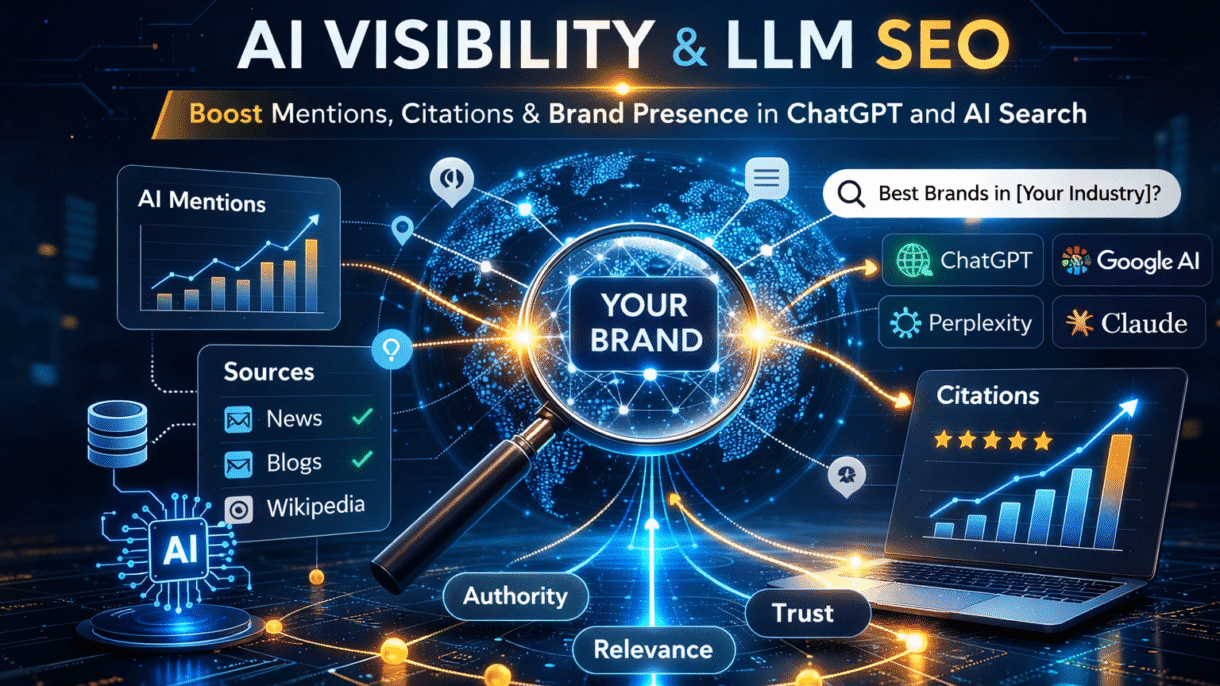

Ever since ChatGPT was launched in late 2023, information retrieval on the internet has undergone a significant transformation. Rather than clicking on links in search engine results pages (SERPs), people now prefer to save time by interacting directly with LLM chatbots. This trend has altered search activity on Google, with ChatGPT processing 1.7 billion search-like requests per day, accounting for 12% of global search traffic.
To respond to this shift, Google launched multiple AI products, including Gemini, AI Mode, and AI Overviews. Combined with the rise of alternative LLMs like Grok, DeepSeek, Claude, and Perplexity, AI-generated responses have continued to expand, displacing the clickable blue links that previously dominated results pages.
This shift has created a new SEO focus: visibility is increasingly about mentions and citations within AI responses, not just traditional rankings.
Why AI Responses Matter for Marketing and Traffic
AI responses are important both as a traffic source and as a marketing channel because:
- People increasingly use AI to discover and research products, tools, and companies.
- The traffic benefits of first-page rankings are diminishing, as AI responses push top-ranking pages further below the fold.
- AI results are more volatile than traditional SERP rankings, creating opportunities for smaller or lesser-known entities to appear in front of their target audience.
- AI responses are highly query-relevant and often more trusted than information found in standard blog posts.
- AI adoption is accelerating across apps, websites, and devices, including customer service chatbots, voice assistants, and IoT gadgets.
These factors make LLM visibility an essential competency in modern SEO and digital marketing.
What is AI Invisibility?
Many brands, people, and organizations are well-known among humans, yet there can be a gap between human knowledge and AI model recall. This phenomenon is known as AI invisibility.
AI invisibility is defined as the gap between human recall and model recall:
Human Recall−Model Recall=AI Visibility Gap\text{Human Recall} – \text{Model Recall} = \text{AI Visibility Gap}Human Recall−Model Recall=AI Visibility Gap
Human recall depends on advertising, education, and cultural exposure, while model recall is based on training data, which includes encyclopedias, research articles, books, and public content.
A gap emerges when AI models fail to recognize entities that are widely known by humans, often due to limitations in their training data or the way information is structured online.
Factors Contributing to AI Invisibility
Four main factors contribute to AI invisibility:
1. Source Asymmetry
If references to an entity are behind paywalls or in closed-source datasets, AI models may underrepresent it. For example, a popular politician who only publishes paywalled articles may be less visible in AI responses than in human awareness.
2. Category Misalignment
How an entity defines itself may differ from how models categorize it. Differences between self-perception and public perception can create misalignment, affecting AI visibility.
3. Absence of Structured Data Anchors
Structured data, such as Product, Person, or Article schema, helps AI models identify and classify entities. Without these “anchors,” AI may fail to recognize important entities.
Analogy: Structured data is to AI what uniforms and badges are to humans. Without them, a random observer might underreport the number of soldiers on a road; similarly, AI underreports entities without schema.
4. Decay Tendencies
AI responses can diminish over time due to model updates, competitive content, or changes in data ingestion. Even repeated prompts may see declining mentions over 30, 60, or 90-day periods.
Why Traditional SEO Metrics Fall Short
Standard SEO metrics are insufficient for measuring AI visibility because:
- Snapshot Bias: AI responses are less consistent than SERPs. The same prompt can produce different answers, making static ranking measures unreliable.
- Framing Bias: Minor changes in prompt wording can significantly change AI responses, unlike traditional keyword rankings.
- Dynamic Decay: AI mentions can disappear or shift as models update, unlike relatively stable search rankings.
To measure AI visibility effectively, new metrics such as occupancy scores have been developed.
Occupancy Scores: Measuring AI Visibility
Occupancy scores are standardized metrics for capturing entity mentions within LLM responses. There are two main types:
1. Answer Space Occupancy
This measures the share of answer surfaces where an entity appears when the same prompt is repeated. For example:
Prompt: “What is the oldest civilization on earth?”
If “Egyptian civilization” appears in 3 out of 4 responses, its Answer Space Occupancy is 75%.
2. Prompt Space Occupancy
This measures the share of related prompts within a category or vertical that mention the entity. Dimensions include:
- Occupancy: % of prompts citing the entity
- Positioning: Average rank of the entity in responses
- Decay: Persistence over time (30/60/90 days)
Example: For acne treatment brands, prompts like “best cream for pimples” and “best cream for blackheads” form a prompt space. If Neutrogena appears in 6 of 7 prompts, its prompt space occupancy is high.
How to Improve Your AI Visibility & Occupancy Scores
1. Be Mentioned in Credible Sources
LLMs learn from reputable content. Secure citations in:
- Media outlets
- Industry publications
- Academic and technical reports
- Reputable directories and knowledge bases
Consistency is key; repeated mentions build credibility with AI models.
2. Increase Industry Centrality
Appear alongside leading entities in your category. Achieve this by:
- Guest writing on respected platforms
- Collaborating with known organizations
- Speaking at conferences and events
Network centrality improves AI recognition.
3. Make Your Website AI-Friendly
Ensure your content is readable and structured:
- Mobile-optimized and fast-loading
- Clear headings and structured layout
- Avoid paywalls on key entity information
- Include About pages, FAQs, and detailed product descriptions
4. Strengthen Associations
Repeatedly link your brand with its industry, category, and geography.
Example: A fintech company in Nigeria should appear alongside African fintech, digital payments, Flutterwave, and Paystack.
5. Use Structured Data
Implement schema markup for:
- Company name and location
- Products or services
- Founders and social profiles
Structured data clarifies identity and relationships for AI models.
Conclusion
LLM SEO is no longer optional—it is essential for brands aiming to be discoverable in AI-driven search. By understanding AI invisibility, measuring occupancy scores, and strategically improving mentions, structured data, and centrality, you can ensure your brand is visible and trusted across LLMs like ChatGPT, Claude, and Perplexity.
Traditional SEO metrics are no longer sufficient; success in AI visibility requires a strategic, multi-layered approach that integrates content, backlinks, schema, and network positioning.